English
Vocabulary
General English
B1+
The Hidden Power of Vocabulary: How Words Shape Thinking and Communication
The Hidden Power of Vocabulary: How Words Shape Thinking and Communication
Word count
547
Expected time
3m
Reading time
00:00
Reading speed
0 WPM
Fully clicked
0
Please login to save your reading statistics.
Premium audio reading
Choose a smoother voice and listen with natural speed.
Ready
Voice
Speed
0.90x
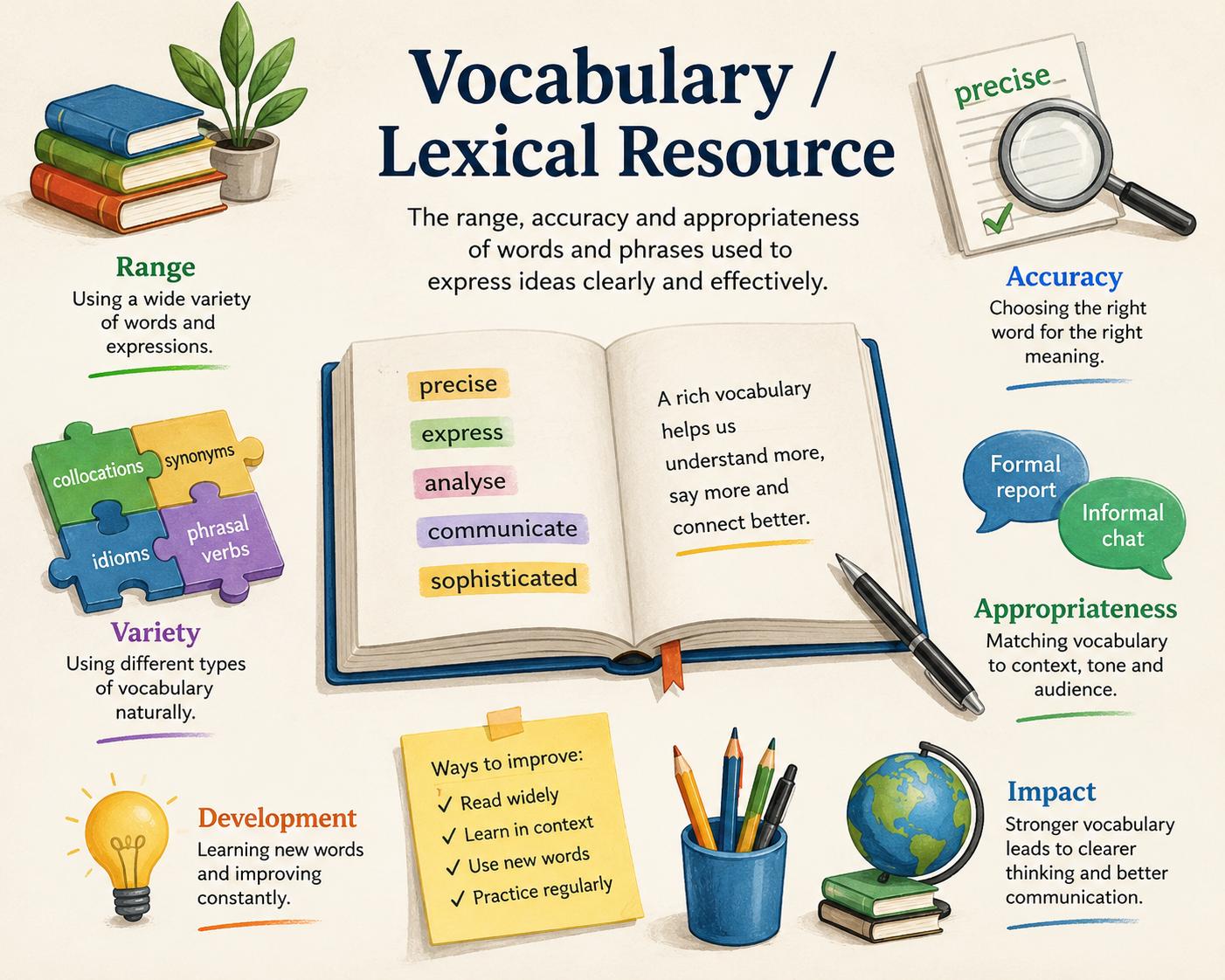
Vocabulary is often seen as a simple list of words to memorise, but in reality, it functions as a powerful tool that shapes how we think, communicate, and interpret the world. Recent research in cognitive linguistics suggests that a richer vocabulary does not only improve language performance, but also enhances conceptual clarity and expressive precision in both spoken and written communication.
One of the most important aspects of vocabulary development is understanding how words naturally combine with each other. These combinations, known as collocations, make language sound more natural and fluent. For example, native speakers typically say “make a decision”, not “do a decision,” or “take responsibility”, rather than “get responsibility.” Learning these patterns helps learners move closer to natural language use.
Another key dimension of vocabulary mastery is the use of idiomatic expressions. Idioms often carry meanings that cannot be understood literally, yet they are widely used in everyday communication. For instance, the phrase “break the ice” refers to starting a conversation in a social situation, while “hit the nail on the head” means to describe something exactly right. These expressions add depth and flexibility to communication, especially in informal and semi-formal contexts.
Researchers also highlight the importance of lexical variety in academic and professional writing. Repeated use of simple words can limit expression, whereas a broader vocabulary allows for more precise argumentation. For example, instead of repeatedly using “important,” writers might use alternatives such as “crucial,” “significant,” or “essential,” depending on context.
However, vocabulary development is not only about memorisation. It is about exposure, context, and active usage. Reading widely, listening to authentic speech, and engaging in meaningful communication are all essential for internalising new expressions.
In practice, learners often encounter five particularly useful collocations that appear frequently in both academic and everyday English:
* make a decision
* take responsibility
* come to a conclusion
* reach a conclusion
* play a role
These patterns are important because they reflect how English is naturally structured, rather than how words appear in isolation.
In addition, several common idioms frequently enrich natural speech:
* break the ice – to start a conversation in a social setting
* hit the nail on the head – to describe something exactly correctly
* a blessing in disguise – something that seems bad at first but becomes good
* burn the midnight oil – to work or study late into the night
* get cold feet – to suddenly feel nervous or lose confidence before doing something
Ultimately, vocabulary is not just about knowing words, but about understanding how they function together to create meaning. Those who develop this awareness are often able to express themselves more clearly, think more precisely, and communicate more effectively across different contexts.
10 useful vocabulary words from the article:
1. collocations – words that are commonly used together in a natural way
2. idiomatic – related to expressions whose meaning is not literal
3. precision – the quality of being exact and accurate
4. conceptual – related to ideas or mental understanding
5. expressive – able to clearly show thoughts or feelings
6. internalising – making knowledge part of your natural understanding through practice
7. lexical – related to words and vocabulary in a language
8. variety – a range of different things
9. context – the situation or environment where something is used or happens
10. fluency – ability to speak or write smoothly and easily without stopping